
Articles in this Volume

Research Article Open Access
Robespierre's perception and misinterpretation of "Rousseauvian Virtue": from the Essay for Rousseau
Article thumbnail
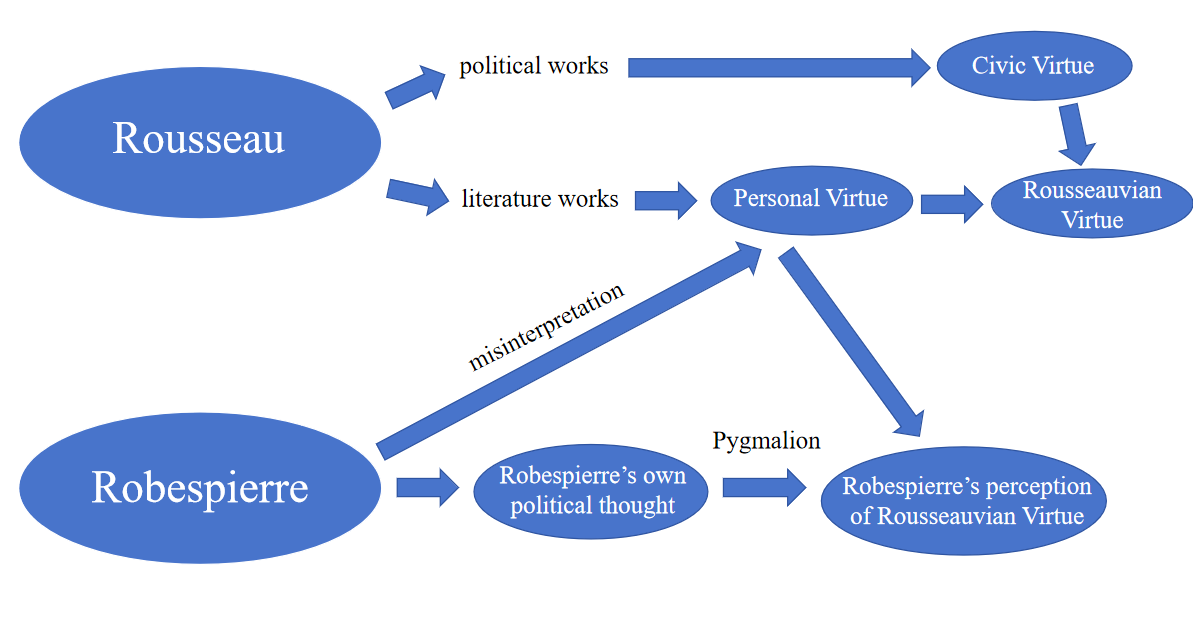
The attempt to realize "Republic of Virtue" by Robespierre was commonly considered to be based on Rousseau's political thoughts and theories from the conventional ideas, while controversial findings could be derived from an essay that Robespierre wrote for Rousseau. This paper is trying to argue that Robespierre had treated Rousseau in a deified and zealous way from his essay for Rousseau, causing his misinterpretation on Rousseau's virtue and the confusion between his own thoughts and those of Rousseau's. Such kind of misinterpretation and confusion could be explained with "Pygmalion" theory in Jean Starobinski's Rousseau studies as a supplement to relevant research on this issue, and also provides an innovative perspective for examining the political-psychological basis of Robespierre, Jacobins' Reign of Terror as well as comparable conditions. For Robespierre had conflated "Civic Virtue" in Rousseau's political theory with the "Personal Virtue" embodied in Rousseau's literary image, the tragedy of Reign of Terror should not be simplistically attributed to Rousseau's theories.

Show more
Read Article PDF
Cite
Research Article Open Access
Deconstructing the mythology of gender in Western films in The Power of the Dog
The film The Power of the Dog, directed by Jane Campion and adapted from the novel of the same name, reexamines the myth of masculinity in the Western genre within the contemporary discourse of "toxic masculinity" and deconstructs it within the framework of gender relations. Through the denaturalization of violence and domination in Western films, the movie exposes the gender ideology and historical-cultural roots underlying the romanticization of male power. Campion's adaptation practice goes beyond merely responding to contemporary social issues; instead, it probes the historical mechanisms through which masculinity is produced, presenting gender identity as something constructed and fluid within cultural practice.
Show more
Read Article PDF
Cite
Research Article Open Access
From "gift of Tianjin" to "community symbol"—the construction and history of Philadelphia Chinatown's Friendship archway
Article thumbnail
The paper examines the Philadelphia Chinatown Friendship archway's transformation from a diplomatic gift to an enduring community symbol, while providing close observations of its architectural details. Constructed in 1984 after Tianjin and Philadelphia announced a sister city tie, the Friendship archway was the first authentic archway built within the United States by Chinese artisans—using Tianjin's Confucian Temple as the reference blueprint. Drawing upon archival records, historical scholarships and recent news documentations, this essay will explore the material biography of the archway and the stories embedded in its physical form. At its core, this study contends that the archway's significance lies not solely on symbolic nor architectural meaning alone, yet in the inseparable union of both. Through its glazed tiles, mineral pigments, and interlocking brackets, the archway narrates the stories of two cultures—confronting and combining. It is a piece of history not told by words, but by the hands that shaped them.
Show more
Read Article PDF
Cite
Research Article Open Access
Philosophical examination of artificial intelligence decision-making: from the perspective of Mao Zedong's investigation thought
The rise of artificial intelligence constitutes not only a revolution in productive forces but also a profound organizational revolution. AI has exerted a far-reaching impact on the leadership and governance approaches of the Communist Party of China (CPC). As artificial intelligence is embedded in the CPC's governance and government administration, the Party's decision-making approach has undergone a major transformation, namely a revolution in decision-making paradigm: a shift from human decision-making to human-machine collaborative decision-making. Human-machine collaborative decision-making may give rise to the practical dilemmas of intelligentism or ideological colonization, where decisions are made on the basis of artificial intelligence. Mao Zedong's investigation thought is isomorphic with the logical process of AI decision-making, while also bearing heterogeneity distinct from artificial intelligence decision-making. In the intelligent era, Mao Zedong's investigation thought still plays a fundamental guiding role, and artificial intelligence can only serve as an auxiliary tool for decision-making. The CPC must take the initiative and hold the right to develop AI, combat data falsification and intelligent hallucination with the spirit of seeking truth from facts, overcome algorithmic bias and the algorithm black box through the mass line and mass intelligence, and resist data monopoly and data hegemony with an independent and self-reliant stance.
Show more
Read Article PDF
Cite
Research Article Open Access
A Study on the co-occurrence constraints of the "to omou" construction
This study examines the "to + omo-u" construction and investigates the co-occurrence conditions among its internal components on the basis of corpus data. Unlike previous studies that focused solely on the formal analysis of case particles or tense forms, this paper approaches the issue from the perspective of the construction as a whole, treating such elements as case particles, predicate types, and verb forms as analytical variables in order to explore their combinatory patterns in actual language use. Through a comparative analysis of the two constructions "Noun + o + V + to + omo-u." and "Noun + o + V + to + omot-ta.", the study finds that the former exhibits a relatively high degree of freedom in verb selection, whereas the latter shows a clear tendency to co-occur with transitive verbs characterized by object orientation and resultativity, displaying a markedly concentrated distribution pattern. Previous studies have shown that "to + omo-u" primarily functions to express the speaker's attitude, while "to + omot-ta" emphasizes the confirmation and narration of past cognitive activity. Based on these findings, this paper argues that the elements within the "to + omo-u" construction do not combine freely; rather, their co-occurrence is constrained by semantic and pragmatic factors. More specifically, a correspondence can be observed among the objectivity marked by "o", the unrealized nature expressed by the volitional form, and the retrospective memory-evoking function represented by "to + omot-ta". This correspondence, in turn, influences verb selection and the naturalness of sentences. From the perspective of the interaction between constructions and lexical items, this study reveals the collocational mechanisms and co-occurrence patterns within the "to + omo-u" construction and provides a new perspective for understanding the usage of cognitive verb constructions in Japanese.
Show more
Read Article PDF
Cite
Research Article Open Access
Fragments traversing the symbolic order: how games reenact ideology — games from the perspective of Žižek's political theory
Within human society, games constitute a form of activity that produces no direct practical utility, yet persist continuously, remain difficult to abandon, and possess distinctive significance. However, the essential nature of games and their intrinsic connection to human desire have not been subjected to sufficiently clear theoretical analysis. This study seeks to draw upon relevant theoretical frameworks to illuminate the relationship between games and human desire, as well as the operational logic underlying games themselves. Building upon the definition of games, this paper employs the theory of ideology developed by Slavoj Žižek to examine the relationship between games and human desire. By corresponding this analysis to the three stages of ideology proposed in Žižek's theory—"in-itself", "for-itself", and "in-and-for-itself"—the study traces the process through which games produce and regulate human desire. The study argues that the existence of games originates from unfulfilled human desire; games operate in the form of ideology, serving and manipulating desires that can never be fully satisfied. The historical development of games' production and regulation of desire corresponds closely to the three stages of ideology identified by Žižek. Furthermore, the ideological nature of games enables subjects to experience an accelerated passage through ideology. As an ideological form of existence, the operational logic of games may ultimately assist subjects in breaking through ideological fantasy and confronting the Real.
Show more
Read Article PDF
Cite